
Riverside Directory Holdings
Riverside has no verified century-long, Riverside-only directory run. The documented Riverside shelf is the Dayton and Montgomery County collection at Dayton Metro Library, supported by county archives and regional research rooms. Preservation Dayton reports that the Main Library has Dayton directories for every year from 1850 to the present, with address data beginning in 1914. That is strong coverage for a Riverside search, but each Riverside volume must still be checked for its title, publisher, geographic scope, and the way it labels suburbs or townships.
| Collection | Verified span or form | Riverside access point | Use with care |
|---|---|---|---|
| Dayton city directories | 1850-current | Riverside researchers use Dayton Metro Library Main and catalog | Check each Riverside volume’s coverage statement. |
| Haines criss-cross volumes | Address data cited from 1914 | Dayton Room, in-library use | Ask which Riverside years are available. |
| Odell’s Dayton Directory and Business Advertiser | Historical title in catalog | Dayton Metro Library catalog | Confirm exact date and Riverside-area scope in the volume. |
| Polk directory headings | Publisher/catalog lineage verified | Dayton Room and catalog | Publisher name does not guarantee Riverside coverage. |
| County Records Center material | Series-specific historical records | Riverside archive counter or narrow request | Pairs a Riverside address with land and probate evidence. |
The lack of a verified Riverside-only run is information, not a dead end. A Riverside directory entry may be filed under Dayton, a suburban edition, Mad River Township, or Village of Riverside. Record the Riverside title page before drawing a conclusion from an absence. Note: A directory listing is a publisher’s dated compilation, not a complete resident roll or a current-address claim.
Riverside Directory Names Before 1995
Riverside became a city in 1995 after the 1994 merger of Mad River Township and the Village of Riverside. That municipal continuity changes how a Riverside city directory search is framed. Older land, school, map, census, and directory material can be correctly connected to today’s Riverside while being indexed under Mad River Township, Village of Riverside, a road name, or a wider Dayton suburban label.
Riverside search terms should follow the record, rather than rewriting it to a modern name. This is especially useful near old road names and across postal labels. Riverside county land records reach far earlier than the city name, including deed materials from 1805 and tract indexes that can follow a legal description through later boundary or address changes.
Dayton Remembers’ 1875 Montgomery County atlas collection provides regional village, township, map, and directory context for this older geography.
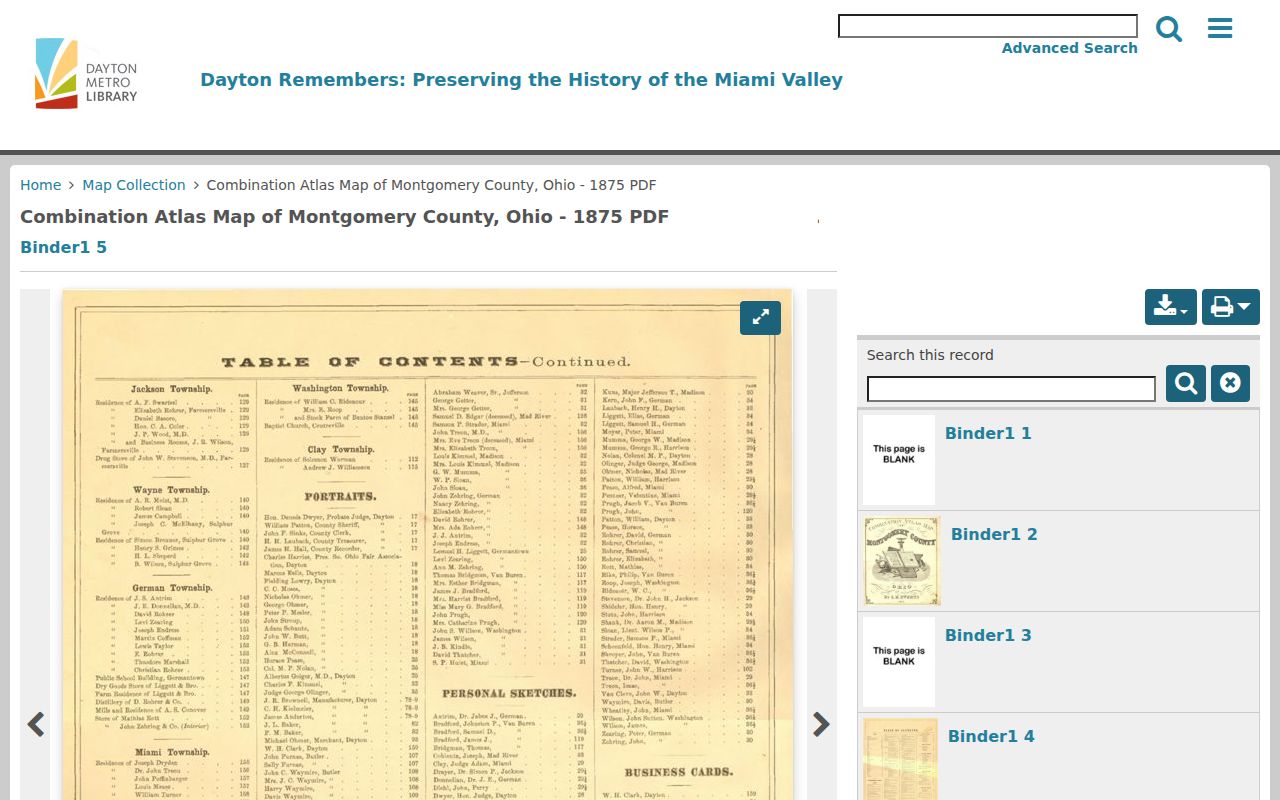
The atlas is a Riverside context source, not proof that a modern Riverside label appears in an 1875 listing. Use it to test Riverside place names and nearby township references before selecting a directory volume.
Riverside Directory Research at Dayton Room
The Dayton Room at Dayton Metro Library is the central regional shelf for Riverside directory work. On the Main Library’s second floor, it holds more than two centuries of Dayton, Montgomery County, and Miami Valley material: directories, maps, newspapers, photographs, manuscripts, microfilm, and genealogy databases. The Room lists Monday through Thursday hours of noon to 4 p.m., with other availability by appointment. Riverside researchers can call 937-463-2665, email history@DaytonMetroLibrary.org, or arrange a consultation.
Its Genealogy Collection is in open stacks during regular library hours. A Riverside visit to the Room can also supply in-library access to research databases, microfilm scanners, Dayton Daily News resources, maps, and local-history staff. Bring the Riverside name spelling, approximate year, address, and known municipality labels. That gives staff a usable request and helps separate an alphabetic directory from a reverse address volume.
Dayton Room
Regional directories, maps, newspapers, genealogy databases, and consultation.
937-463-2665
Records Center
Historic deeds, probate, tax, naturalization, and legal-description indexes.
937-225-6366
A library directory is best read beside the county’s land or probate record, not in isolation. The modern address-keyed trail belongs with the Riverside street directory records, while the Dayton Room supplies the historical compiled listing.
Riverside Directory Criss-Cross Volumes
The library catalog identifies the Haines Dayton City & Suburban Criss-cross Directory as in-library use. A Riverside criss-cross volume reverses the usual name-first arrangement: it is arranged by address, then points to a listed name or business in that edition. Preservation Dayton’s cited address-data start of 1914 helps establish when this method becomes plausible, but the exact Riverside volume and its geographic coverage still need a Dayton Room check.
The Dayton Metro Library directory catalog search is the appropriate first online stop for Haines, Odell, and Polk-related holdings.
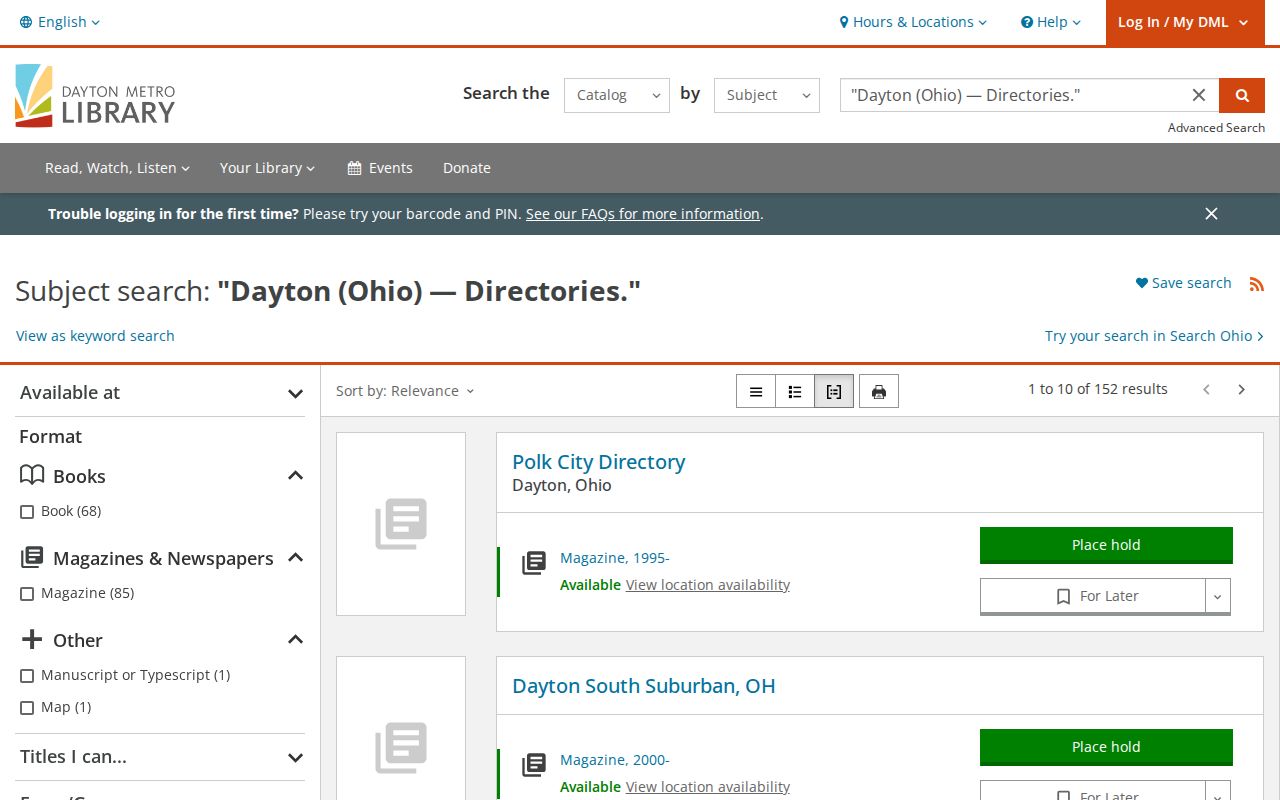
The catalog establishes that the regional Riverside directory shelf exists. It does not verify that a particular Riverside address is listed, so request the Riverside year and inspect the volume’s title page and street-page header.
- Criss-cross directory
- An address-ordered directory section used to move from a street address to a listed name or business.
- Householder index
- A name-ordered list that may represent the person or household the publisher chose to include, not everyone present.
- Abbreviation key
- The volume’s explanation of its short forms; capture it because symbols and labels can differ by publisher and year.
Reading Riverside Directory Entries
A Riverside directory entry must be transcribed from the actual Riverside page, not reconstructed from a modern assumption. The research supports a cautious inventory: surname and given name, occupation or employer where printed, residence address, spouse or widow notation where the publisher uses it, possible business designation, and the publisher’s abbreviations. Not every Riverside entry carries every field, and a printed address does not by itself establish legal ownership.
| Name order | Usually surname followed by given name; preserve initials, suffixes, and spelling as printed. |
|---|---|
| Work or business text | May identify an occupation, employer, or business connection in that edition. |
| Residence line | A dated publisher listing, useful for a lead but not a complete household finding. |
| Family notation | Spouse or widow wording may appear where the publisher included it; do not assume it is universal. |
| Volume context | Title, publisher, year, coverage, abbreviation key, page, and street-page reference should travel with the transcription. |
Photograph or copy the page header and adjacent lines as well as the entry. Nearby lines can expose a street-page break, a numbering pattern, or a clue that the location is outside the edition’s intended area. Note: The volume’s own abbreviation key controls the meaning of its symbols.
Riverside Directory Coverage Gaps
Haines, Odell, and Polk are useful Riverside shelf terms, not interchangeable proof of a continuous Riverside run. Haines is specifically cataloged as a Dayton City & Suburban criss-cross resource. Odell’s Dayton Directory and Business Advertiser is a cataloged historical title. Polk appears through publisher and catalog headings. The safe Riverside practice is to write down the publisher, edition year, stated coverage, and whether the entry sits in an alphabetic or address section.
A missing name can mean a move, a death, a publisher change, a coverage boundary, a renamed or renumbered address, a different spelling, military service, or an omission. It cannot be treated as a final answer. Riverside’s older Mad River and suburban labels make that caution especially important. County tract or deed indexes offer a stronger bridge when a street number stops matching across years.
The Montgomery County Records Center & Archives is the offline Riverside fallback for older deeds, tract material, estates, marriages, tax records, and maps. Its detailed guide lists deed name indexes for 1805-1928 and tract/legal-description abstracts for 1805-1986. Bring the Riverside legal description or book reference when possible; county materials describe different deed-series end dates, so staff should identify the correct series for the target book.
Riverside Directory Names in HOBITS
For Riverside family history, the Dayton Obituary and Genealogy Database, known as HOBITS, can turn a directory name into a dated newspaper citation. HOBITS is a free citation index, not a full-text obituary archive. Its documented coverage includes 1850-80, 1897-98, 1900, 1903-18, 1920-39, 1951-57, 1965, and 1985-present, plus additions. Those Riverside gaps should be recorded rather than treated as missing life events.
Search the Dayton Obituary and Genealogy Database by keyword, name, first name, last name, publication, date, or a known citation field such as volume, issue, page, or column.
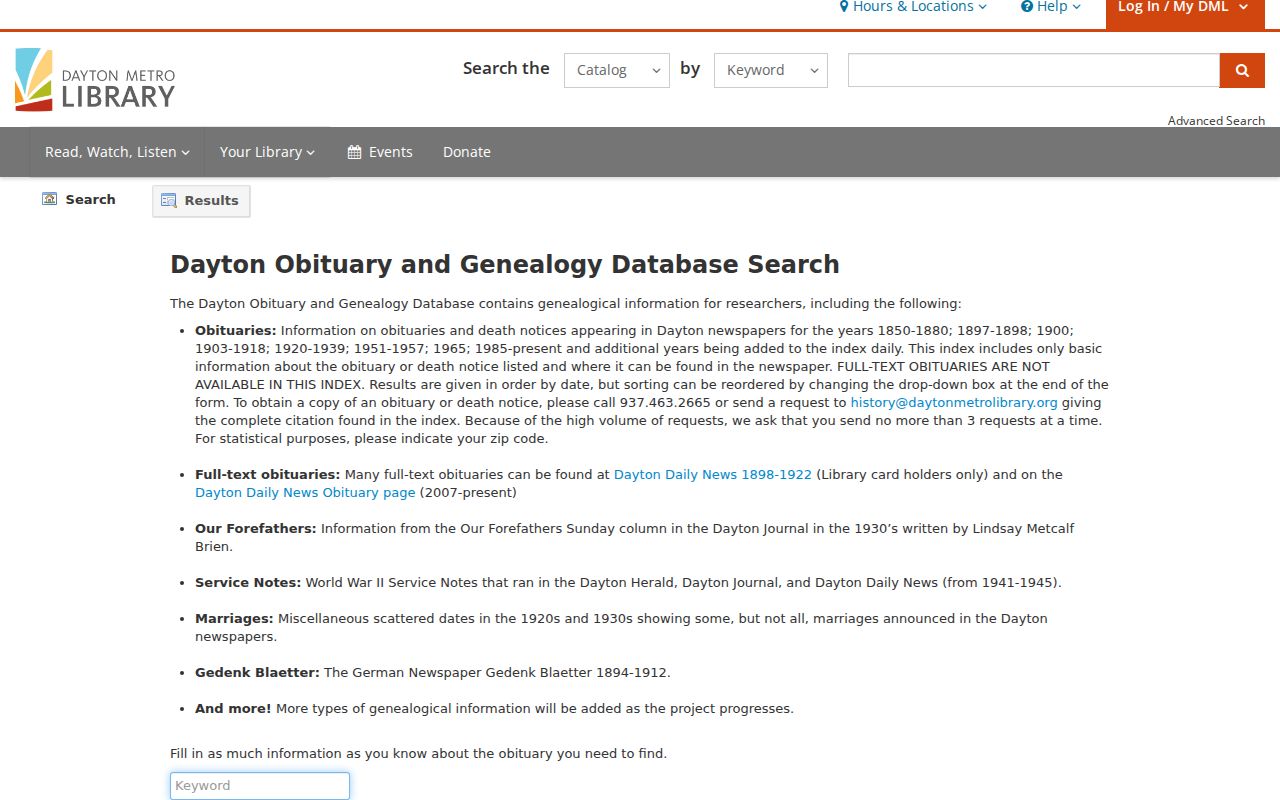
Save the complete citation returned by HOBITS and request the copy from the Dayton Room. The library asks for no more than three obituary or death-notice copy requests at a time, by phone or email.
This is a human-use bridge: a directory year can establish a dated listing, while an obituary citation or probate file may identify a later family-history endpoint. Neither record should be used to infer a current address for a living person.
Tracing Riverside Directory Families
A careful Riverside directory trail moves one dated source at a time. Start with a current Riverside parcel or a documented Riverside address rather than a remembered street number. Note the current Riverside municipality, parcel ID, legal description, ZIP, and spelling shown by the Auditor. Then select the closest available reverse directory, cross to the same year’s alphabetic section, and preserve both citations. The name may need later confirmation in a voter, probate, deed, or court record through the Riverside resident lookup route.
- Locate the nearest Haines or other address-ordered volume, then capture the page header and adjacent address lines.
- Cross to the same year’s alphabetical directory and copy the name spelling, printed address, and any published notation exactly.
- Move one volume at a time forward and backward, noting moves, coverage changes, and changed street labels without guessing why they occurred.
- Pair a directory year with a federal census where available. The 1950 census is the latest released federal census under the 72-year rule.
- Use Recorder, tract-index, probate, HOBITS, newspaper, and archive material to test the dated trail.
That sequence distinguishes a directory-listed person from a recorded owner, a tax mailing recipient, or a census household. It also makes a gap useful: an unexplained disappearance becomes a focused question for the Dayton Room or County Records Center, rather than a claim.
Riverside Directory Archive Paths
When the Dayton Room catalog does not answer a Riverside question, regional Riverside archives provide a second shelf. Dayton History’s Archive Center holds social, cultural, economic, religious, and political collections for the region, with research service listed at $50 an hour after a free first half hour, or $75 an hour for rush work. Wright State Special Collections is another Riverside county-identified route for local-government records, manuscripts, family histories, and genealogy material.
Dayton History’s research collections page describes its holdings and research-service route.

These holdings add context, photographs, manuscripts, and organization records where a directory does not. They do not replace the Dayton Room directory shelf or create a verified Riverside-only historical directory sequence.